

Safe Motherhood Day: No Woman Should Die in Childbirth as Nigeria Launches New Clinical Tools to Cut Maternal Deaths
By Joy Onu
Efforts to strengthen maternal health outcomes took centre stage at the 2026 Safe Motherhood Day commemoration in Abuja, where government officials, development partners and health stakeholders reviewed progress and introduced new policy instruments aimed at improving care for mothers and newborns across Nigeria.
The Federal Government used the occasion to reaffirm its commitment to reducing maternal and newborn deaths, with renewed emphasis on improving the quality of services delivered in health facilities nationwide.
The Coordinating Minister of Health and Social Welfare, Muhammad Ali Pate, represented by the Permanent Secretary of the Ministry, Daju Kachollom, said Nigeria is “shifting decisively from expanding access alone to ensuring that every contact with the health system delivers safe, effective and respectful care for women and newborns.”
Earlier, in her welcome remarks delivered by the Permanent Secretary-Designate, Kachollom said the government remains committed to improving outcomes, stressing that “coverage without quality will not deliver the results we need as a nation.” She added that ongoing reforms are focused on strengthening service delivery and system performance across all levels of care.
She highlighted the Maternal Mortality Reduction Innovation Initiative (MAMII), now active in 32 states, describing it as “a targeted, data-driven response to where maternal deaths are most concentrated.” She also noted that the National Emergency Medical Service and Ambulance System has expanded reach, with operations ongoing in 136 of the 172 participating local government areas.
More than 600 ambulances have been deployed to support emergency referrals, with pregnant women accounting for a significant share of cases handled under the system.
Through the National Health Insurance Authority, over 32,000 women and about 1,700 newborns have accessed Comprehensive Emergency Obstetric and Newborn Care across more than 250 health facilities, in efforts to ease financial barriers to lifesaving treatment.
In a separate intervention, more than 166,000 pregnant women previously outside the health database have been traced and linked to primary healthcare centres across Jigawa, Kaduna, Kano, Katsina, Kebbi, Yobe, Sokoto and Zamfara, as part of ongoing community tracking and referral efforts.
The ministry also confirmed the distribution of over 111,000 maternal delivery kits nationwide, while additional supplies are being procured to strengthen services in priority local government areas.
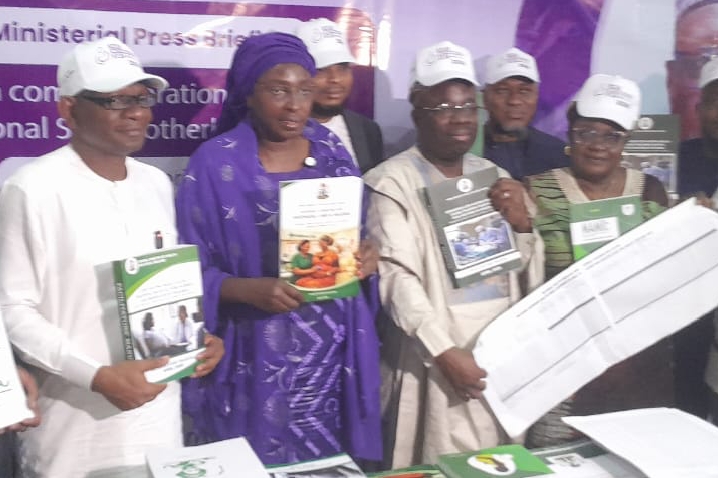
A major highlight of the commemoration was the unveiling of new clinical AND policy instruments, including the National Antenatal Care Guidelines, the National Clinical Service Protocol for Obstetrics and Newborn Care, the revised Life Saving Skills training package, the Maternal and Newborn Health Product Introduction Plan, maternal health reporting tools, and the MAMII implementation guide.
The ministry said the documents are designed to standardise care, reduce variation in clinical practice, and strengthen the capacity of frontline health workers to respond to emergencies such as postpartum haemorrhage and eclampsia.

Stakeholders at the event, including the World Health Organization, the National Council of Women Societies and development partners, welcomed the reforms but called for sustained funding, stronger accountability mechanisms, and closer coordination across federal, state and local health systems.
The Federal Government maintained that the direction is now firmly set, with participants unanimously reinforcing a shared message that “no woman should die while giving life in Nigeria.”
