

By Joy Onu, Abuja
Nigeria’s road and bridge network is facing mounting pressure from vandalism, overloading, and illegal activities, the Minister of Works, David Umahi, has warned, urging citizens to see the protection of public infrastructure as a shared national duty.
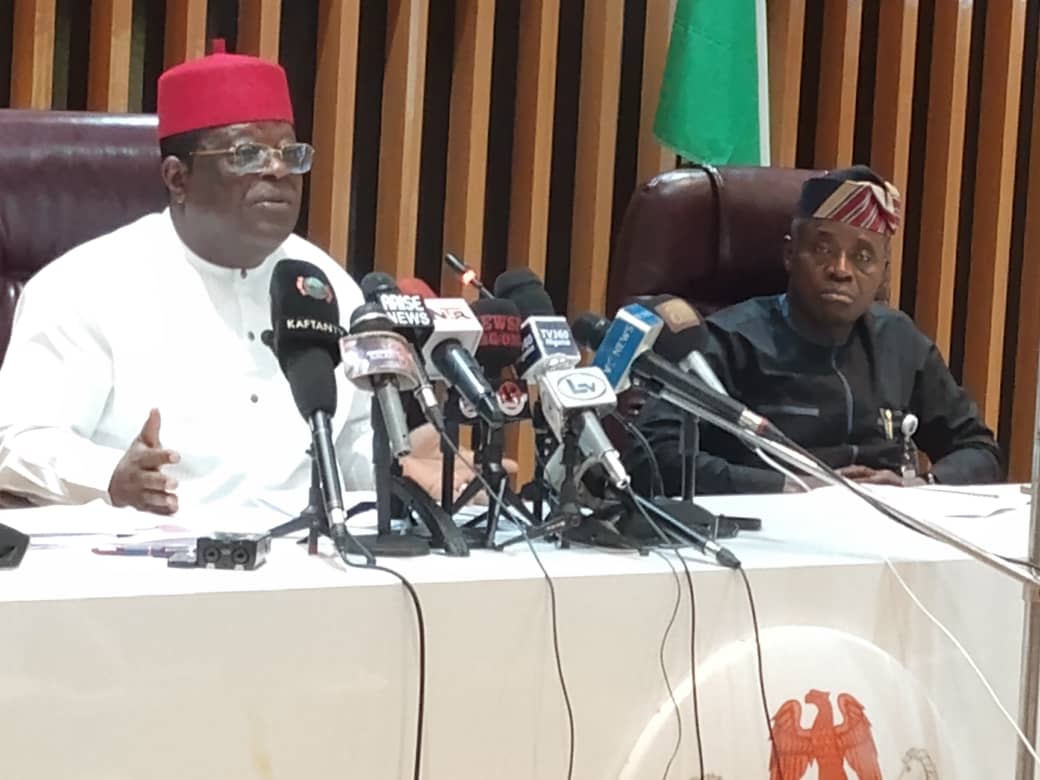
Speaking at a media briefing at the headquarters of the Ministry of Works in Abuja on Thursday, Umahi said the scale and persistence of sabotage across highways and bridges now pose a serious risk to public safety and the sustainability of government investments.
The minister disclosed that vandals have increasingly targeted expansion joints, steel reinforcements, electrical fittings and reinforced concrete barriers on major roads and bridges, including the Niger Bridge, the Cumberland Bridge, the Abuja–Kaduna–Zaria–Kano road and the Second Niger Bridge. According to him, some of these components are removed and melted down for scrap, weakening structures that were never designed for such losses.
He revealed that security agencies recently arrested suspects who stripped vital components from the Cumberland Bridge, stressing that the incident reflects a wider national pattern rather than an isolated case. Umahi explained that many of Nigeria’s bridges were originally designed for about 30 years of service and specific load limits, a balance now disrupted by both heavy-duty truck overloading and deliberate vandalism.
“When you combine excessive loading with the removal of structural parts, you create a dangerous situation,” he said, warning that continued abuse could lead to avoidable disasters.
Umahi also raised alarm over illegal activities undermining infrastructure foundations, particularly sand mining around bridge piles. He explained that several bridges depend on steel friction supported by surrounding sand, and excavation around these areas has compromised their stability. Structural concerns, he said, have already been identified on the Third Mainland Bridge and the Carter Bridge in Lagos, with expert assessments indicating that the latter will eventually require demolition.
While temporary engineering measures are being applied to extend the Carter Bridge’s lifespan by about three years, Umahi cautioned that bridges are not designed to withstand static loads from parked heavy trucks, a practice he described as increasingly common and dangerous.
On flooding along sections of the Lagos coastal highway, the minister attributed the problem to blocked underground drainage systems, blaming indiscriminate waste disposal. He said refuse dumped into manholes had obstructed water channels, contributing to flooding in parts of the city and damaging newly built infrastructure.
During a recent inspection tour in Lagos, Umahi said he observed repeated destruction of protective installations along the coastal route, including green barbed wire installed to secure and beautify the corridor. He noted that even where sections remain unfinished—such as the Shagamu–Owode road, designed with a 12-metre right-of-way but currently paved to nine metres—pedestrians and vandals continue to breach steel barriers meant to protect construction zones.
The minister commended Lagos State Governor Babajide Sanwo-Olu and security agencies for deploying personnel to protect the coastal highway, but stressed that enforcement alone cannot solve the problem without public cooperation.
Beyond vandalism, Umahi addressed political criticism surrounding the termination of a major road contract awarded to Julius Berger by the previous administration. He explained that while the current government reviewed the contract and approved a revised sum of ₦1.1 trillion, the contractor insisted on ₦1.5 trillion. The ministry, he said, subsequently identified another construction firm willing to deliver the project for just over ₦700 billion.
The issue was raised during the ministry’s budget defence before the Senate Committee on Works, where Umahi also pushed back against what he described as unfair attacks on himself, the ministry, and the administration he serves. He alleged that some lawmakers were aggrieved over the ministry’s refusal to allocate constituency projects.
“I will defend myself, the ministry and the government I am serving,” the minister said, insisting that decisions were guided by value for money and public interest.
Umahi praised President Bola Tinubu for introducing reinforced concrete technology in road construction, noting that the approach could extend the lifespan of new roads to between 50 and 100 years, compared with older designs that failed within a decade. He added that CCTV systems recently installed on the Third Mainland Bridge at the president’s directive have already helped security agencies track and arrest suspects involved in theft and sabotage.
Despite these efforts, the minister warned that no level of engineering innovation can compensate for deliberate destruction. He said the ministry has begun deploying additional protective technologies on key bridges and called for stronger public awareness campaigns to discourage vandalism.
“No government can deliver infrastructure in perfect order if the same infrastructure is being destroyed,” Umahi said. “These assets belong to all of us. If we fail to protect them, the cost will be higher repairs, disrupted movement and, ultimately, loss of lives.”
He urged Nigerians to take collective responsibility for safeguarding public infrastructure, warning that repeated damage drains public finances and slows national development.
