

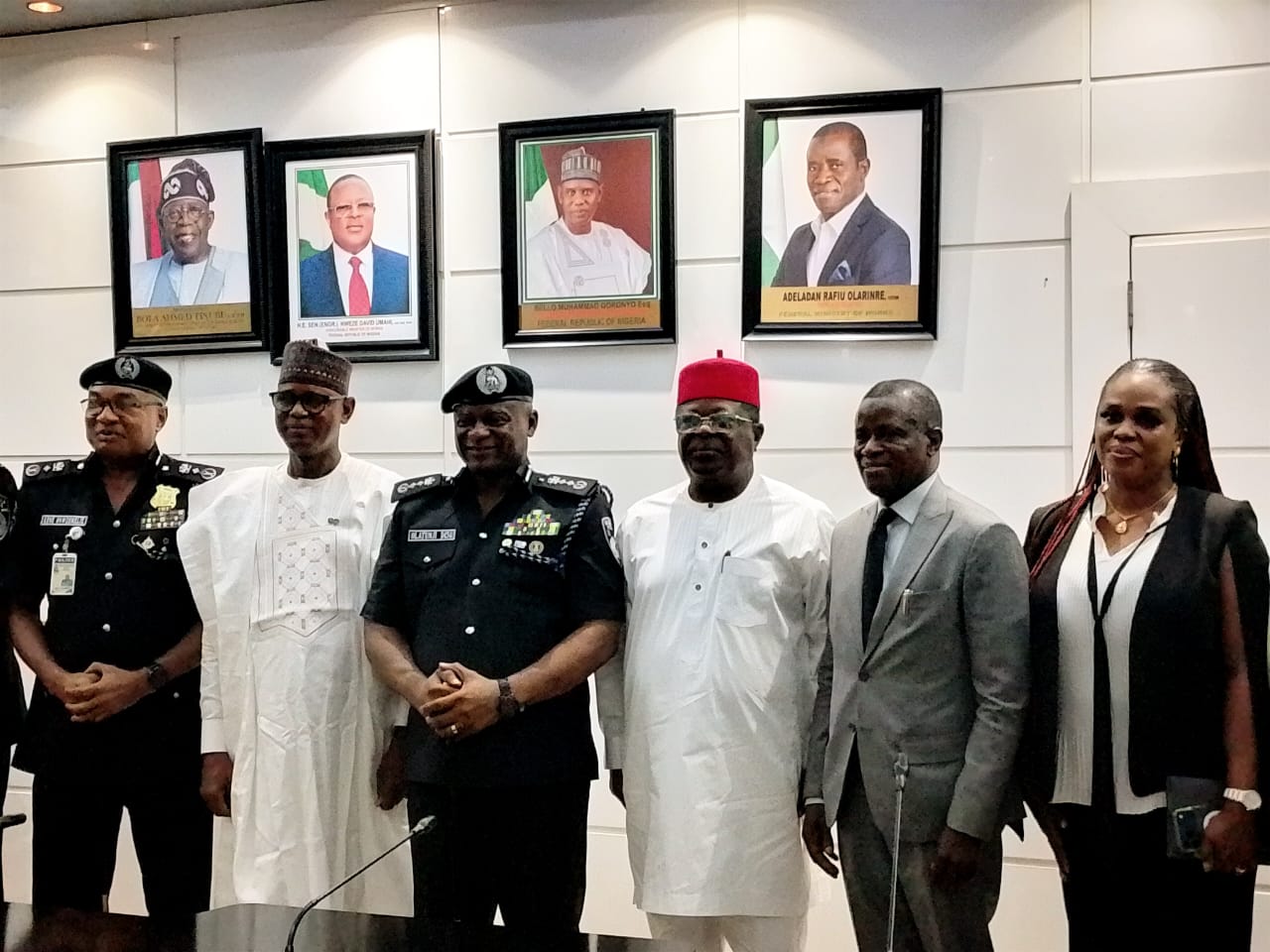
The Federal Ministry of Works and the Nigeria Police Force have reinforced collaboration on the protection of federal road infrastructure nationwide, as the Inspector-General of Police, Olatunji Rilwan Disu, paid a strategic courtesy visit to the Minister of Works, David Umahi, in Abuja on Monday
The engagement, held at the ministry’s headquarters in Mabushi, focused on improving security architecture around major highway construction corridors, including the Federal Government’s flagship legacy projects under President Bola Ahmed Tinubu.
Welcoming the delegation, the Minister of State for Works, Bello Muhammad Goronyo, described the visit as timely and strategic, noting that road infrastructure remains central to the administration’s economic transformation agenda.
Goronyo commended the leadership of the Works Ministry for what he described as visible progress in the delivery of key national road projects, while also praising President Tinubu for sustained support for infrastructure development. He called for stronger inter-agency cooperation to address security challenges affecting active project sites across the country.
The Inspector-General of Police said road infrastructure remains critical to national development, stressing that improved connectivity would boost economic activity and reduce crime in affected communities. He noted that the police would require structured operational presence along major highways, including patrol points, surveillance systems, and operational control units to enhance response capacity.
“You are building the future of this country through infrastructure. Roads do not only move people; they move opportunity and development,” he said, while appealing for operational support such as patrol and armoured vehicles to strengthen highway security operations nationwide. He added that strategic projects like the Lagos-Calabar Coastal Highway would significantly boost tourism and economic activity upon completion.
Responding, the Minister of Works, David Umahi, commended the police and other security agencies for their continued support in safeguarding project sites despite prevailing security challenges in some parts of the country. He noted that several projects would have suffered serious delays without such intervention.
Umahi stressed that infrastructure delivery must align with security planning, explaining that modern highway development now integrates surveillance systems, lighting, and response infrastructure. He disclosed that CCTV installations, solar-powered lighting, and security observation posts are already being deployed on selected corridors, including sections of the Lagos-Calabar Coastal Highway and the Third Mainland Bridge, with similar measures planned for other strategic highways nationwide.
He described the administration’s flagship highway projects as long-term investment corridors designed to stimulate economic growth, enhance logistics, and strengthen national integration. According to him, these include the Sokoto-Badagry Super Highway, Lagos-Calabar Coastal Highway, Calabar-Abuja Corridor, and the Akwanga–Jos–Bauchi–Gombe route.
Umahi urged Nigerians to engage government policies with constructive criticism, stressing that national development requires collective responsibility and stronger civic participation, particularly through credible intelligence sharing with security agencies.
The Permanent Secretary of the Ministry of Works, Mr Adeladan Rafiu Olarinre, in his closing remarks, appreciated the Inspector-General of Police and his delegation for the visit and reaffirmed the ministry’s commitment to sustained collaboration with security agencies to ensure the delivery and protection of federal highway projects nationwide.
