

By Victoria Attah
Nigeria’s Federal Government has stepped up efforts to rebuild its once-thriving cotton, textile and garment industry, unveiling a more structured recovery approach aimed at fixing long-standing gaps across production, financing and distribution.
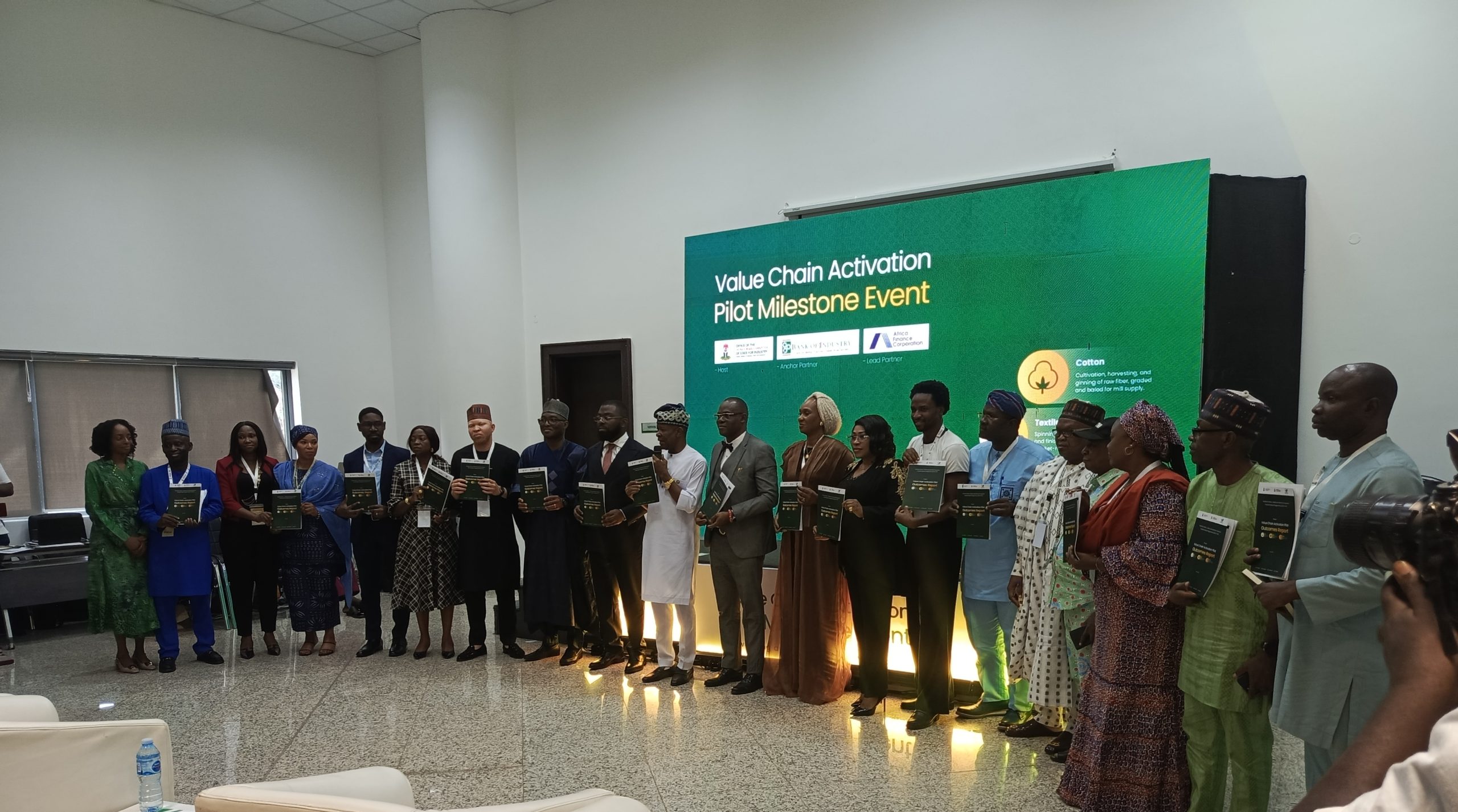
The renewed direction was laid out on Thursday at the CTG Value Chain Activation Phase I milestone event in Abuja, where stakeholders gathered at the Bank of Industry conference room to assess a pilot intervention now being positioned as the foundation for a nationwide industrial reset.
Leading the policy charge, Minister of State for Industry, Senator John Owan Enoh, said the government is now working with a clearer implementation map rather than broad policy declarations, insisting that the sector’s revival must be evidence-based and phased.
He explained that the pilot programme was intentionally limited in scope to allow government and industry operators identify weak points across the cotton-to-garment chain before expanding interventions nationwide.
“What we have done is not selection, but diagnosis. The objective was to understand where value is created, where it is lost, and how to rebuild a system that works end-to-end,” Enoh said.
The minister added that the next phase would focus on deepening integration among actors in the sector, with emphasis on building structured linkages between cotton growers, textile processors and garment manufacturers to improve coordination and output efficiency.
He also disclosed that government is finalising a policy framework to govern the CTG sector, which is expected to be unveiled mid-year, and will serve as the anchor for investment, financing and industrial regulation. According to him, the administration is determined to reposition the textile industry as a major employment engine and import-substitution platform within Nigeria’s broader industrial agenda.
At the institutional level, the Permanent Secretary of the Federal Ministry of Industry, Trade and Investment, Dr. Chris Osa Isokpunwu, described the initiative as a deliberate attempt to reconnect Nigeria with a sector that once formed a backbone of its manufacturing economy. He said the textile industry previously supported large-scale employment and agricultural production, but suffered structural decline over the years due to weak infrastructure and fragmented policy execution.
Dr. Isokpunwu noted that current projections from the programme indicate the sector could generate over 1.4 million jobs annually if fully revived and effectively coordinated across its value chain. He stressed that the CTG initiative is designed to align policy direction with financing systems and production realities in order to deliver measurable industrial outcomes.
On financing, the Managing Director of the Bank of Industry said the institution is preparing targeted credit instruments to support factory rehabilitation, capacity expansion and new investments in textile and garment clusters. He said access to long-term funding remains critical to unlocking idle production capacity across the sector and ensuring that operators can scale sustainably.
The Managing Director of the Bank of Agriculture, Mr. Ayo Sotinrin, also expressed confidence in the sector’s potential, noting that Nigeria already holds key advantages in raw materials, labour and domestic demand. He called for financing models that reflect the interconnected nature of the CTG ecosystem, stressing that support must cover the entire chain from cotton cultivation to finished garments.
The Director of Industrial Development at the Ministry, Mrs. Olumuyiwa Ajayi-Ade, said the programme is shifting the sector away from fragmented interventions towards a coordinated industrial framework driven by measurable outcomes. She explained that the initiative will expand cotton production, strengthen textile capacity and stimulate garment manufacturing, while creating space for SMEs to participate more actively in the value chain.
Representatives of the African Finance Corporation, the United Nations Industrial Development Organization and the Raw Materials Research and Development Council said the pilot phase has provided a clearer roadmap for sector-wide revival.
They said sustained implementation, improved access to capital and stronger coordination across stakeholders would be critical to turning the CTG sector into a competitive industrial base once again.
For government officials, however, the message from Abuja was less about nostalgia and more about execution, whether Nigeria can finally convert decades of policy discussions into a functioning textile economy that produces, employs and exports at scale.
