

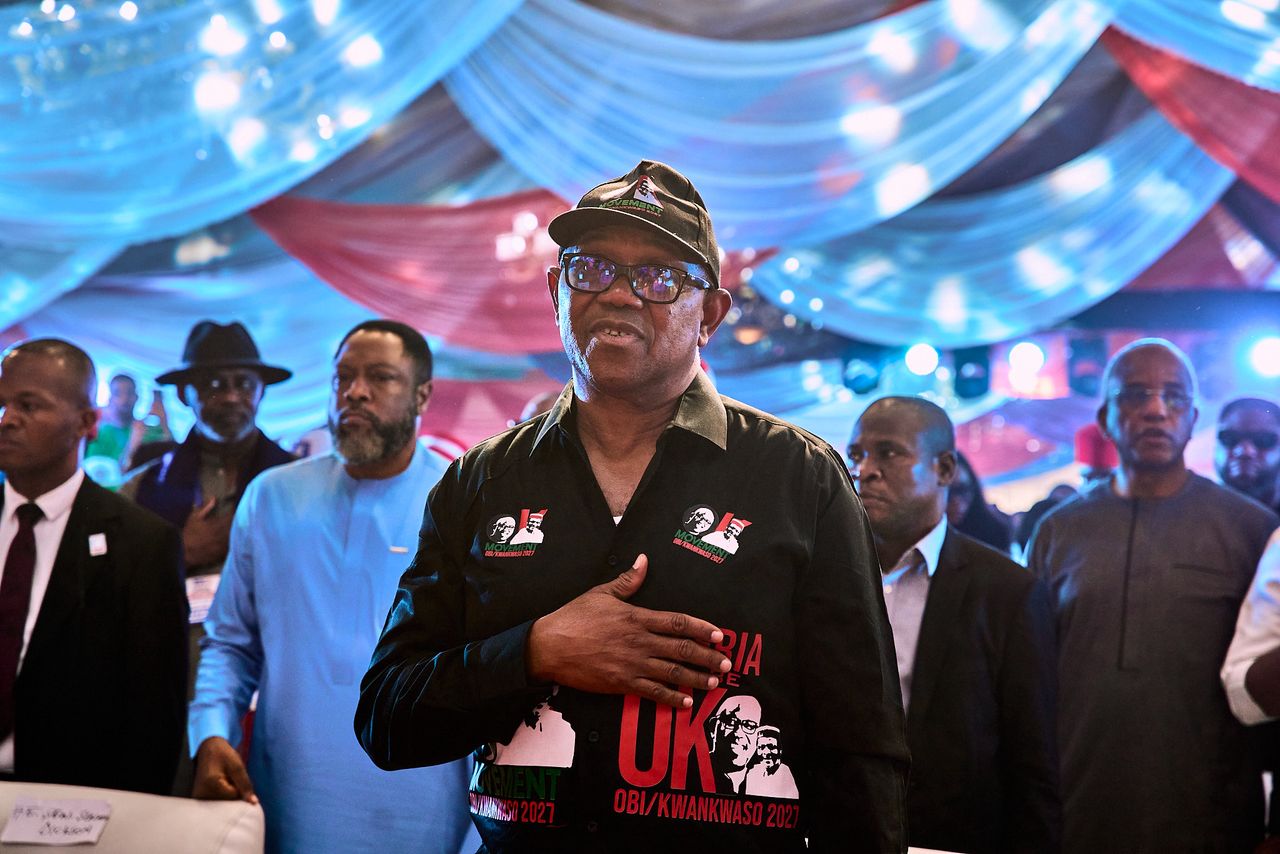
Presidential hopeful, Mr. Peter Obi, on Friday formally accepted the presidential nomination of the Nigeria Democratic Congress (NDC), declaring that “a New Nigeria is Possible” as he unveiled a broad reform blueprint touching security, economy, governance, education, and national unity ahead of the 2027 general election.
Speaking at the party’s national convention in Abuja, Obi expressed gratitude to party leaders, including the National Chairman, former Bayelsa State Governor, Seriake Dickson, the National Working Committee, and party delegates who converged from across the country to endorse his candidacy under the platform of the Nigeria Democratic Congress.
“It is with deep humility that I accept the role of presidential candidate,” Obi said, positioning his candidacy as a national renewal project rather than a personal ambition.
Obi anchored his acceptance speech on a recurring theme of national rebirth, warning that Nigeria stood at what he described as a “crucial juncture” marked by uncertainty, economic strain, insecurity, and declining public confidence in governance.
He argued that the country’s challenges had weakened trust in institutions and deepened hardship among citizens, but maintained that Nigeria’s diversity remained its greatest strength rather than a source of division. “Nigeria cannot advance while fragmented by ethnic, religious, regional, or political divides,” he said, calling for national healing and unity.
On security, Obi painted a grim picture of Nigeria’s worsening global terrorism ranking, noting a steady rise in its vulnerability index in recent years.
He, however, referenced Nigeria’s historic contributions to international peacekeeping missions, citing past deployments across Africa, the Middle East, and Asia as evidence of the country’s capacity for disciplined military engagement.
Obi promised a shift toward intelligence-driven, technology-enhanced and community-focused security architecture, while pledging better coordination among security agencies and stronger welfare for personnel.
“No nation can thrive while its citizens live in fear,” he said.
On healthcare, Obi decried Nigeria’s global ranking in health system performance, lamenting the poor functionality of primary healthcare centres nationwide.
He pledged that if elected, his administration would ensure that at least 50 per cent of Nigeria’s estimated 30,000 primary healthcare centres become fully functional within four years, alongside a nationwide staffing and infrastructure upgrade.
He also proposed raising health insurance coverage from about 10 per cent to over 20 per cent, while committing to increased health sector funding and improved workforce development as he described education as central to national transformation, stressing that no country rises above the quality of its human capital.
He also raised concerns over Nigeria’s worsening food insecurity, citing global hunger indices that place the country among nations with severe food challenges.
Comparing Nigeria’s agricultural potential with major rice-producing countries such as India, Bangladesh, and Vietnam, he argued that Nigeria’s vast landmass remains underutilised despite its population size. “We have no justification for being among the world’s hungriest nations,” he said, calling for a shift from consumption to production-driven agriculture.
On energy, Obi highlighted Nigeria’s low electricity generation capacity despite its large population, contrasting it with peer nations that generate significantly higher megawatt outputs.
The presidential candidate pledged to raise power generation capacity substantially within four years, describing reliable electricity as the backbone of industrial growth.
On unemployment, he said Nigeria’s official figures underestimate the crisis, noting that youth unemployment and underemployment remain critically high. He promised targeted support for micro, small, and medium enterprises (MSMEs), including tax incentives and improved access to credit.
Obi also pledged stricter accountability in public finance management, promising a measurable reduction in corruption and governance costs, while he emphasised that the rule of law would be upheld without compromise, and vowed to strengthen democratic institutions while promoting inclusive governance. “Democracy will be by the people, for the people, and of the people,” he said.
In a major political announcement that drew attention at the convention, Obi confirmed that former Kano State Governor and presidential contender, Rabiu Kwankwaso, would serve as his running mate. He described the choice as part of efforts to build a broad-based national coalition and strengthen unity across geopolitical lines.
Obi brought his speech to a close with a call for national renewal and collective responsibility, urging Nigerians to embrace hope and shared purpose.
“May God bless the Federal Republic of Nigeria,” he said.
