

By Joy Onu
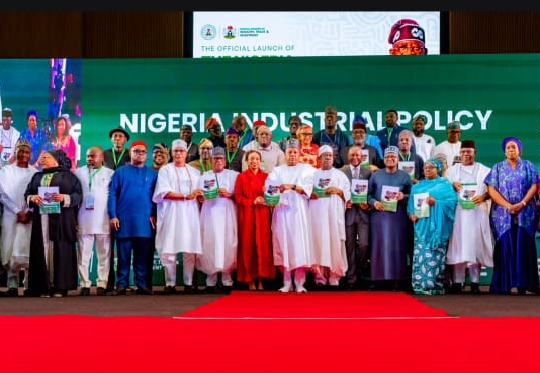
Nigeria is taking a bold step toward becoming a production powerhouse. On Tuesday, February 17 2026, the Federal Government launched the Nigeria Industrial Policy (NIP) 2025, a roadmap aimed at turning the nation from a consumption-driven economy into a hub of manufacturing, value addition, and global competitiveness.
In a press release issued today by Augustina Obilor-Duru, Head, Press and Public Relations, President Bola Ahmed Tinubu, GCFR, represented by Vice President Kashim Shettima, GCON, hailed the policy as the fulfillment of the administration’s promise to move Nigeria “from potential to productivity.” He described NIP 2025 as a practical plan to rebuild industries, strengthen value chains, create jobs, and make Nigerian products competitive on the global stage.
“Industrialization is not a one-off effort; it requires coordination across energy, infrastructure, trade, finance, skills, and innovation,” President Tinubu said. “Success will be measured by results, not rhetoric, driven by strong partnerships between government and the private sector.”
The policy targets sectors where Nigeria has natural advantages, deepens value-chain development, integrates micro, small, and medium enterprises, and strengthens infrastructure, energy, and technology. It also sets a clear framework for accountability, ensuring measurable progress.
Senator John Owan Enoh, Minister of State for Industry, called the launch “a defining moment for Nigeria,” highlighting the administration’s shift from fragmented initiatives to coordinated action. He pointed to the shea value chain as a success story: banning raw shea nut exports sparked domestic processing, expanded crushing capacity, boosted farmer incomes, and increased exports of processed shea products—all within a year.
The policy addresses critical needs for producers, including power stability, infrastructure, access to finance, skills development, and regulatory certainty. “Industrialization is a shared responsibility,” Minister Enoh said. “Government provides clarity; industry invests, innovates, and creates jobs.”
With a focus on agro-processing, textiles, petrochemicals, pharmaceuticals, metals, and tech-driven industries, NIP 2025 also positions Nigeria to leverage the African Continental Free Trade Area, serve domestic markets, and emerge as a production hub for West Africa. By strengthening value chains, boosting non-oil exports, and generating quality employment, the policy sets Nigeria on a path to sustained industrial growth.
President Tinubu affirmed that “the work begins immediately,” signaling a new era of production, prosperity, and economic transformation for Nigeria.
