

By Victoria Attah
Nigeria has renewed pressure on the international community to adopt binding rules on health worker migration, arguing that Africa’s health systems are being weakened by a continuous outflow of trained professionals without reciprocal investment.
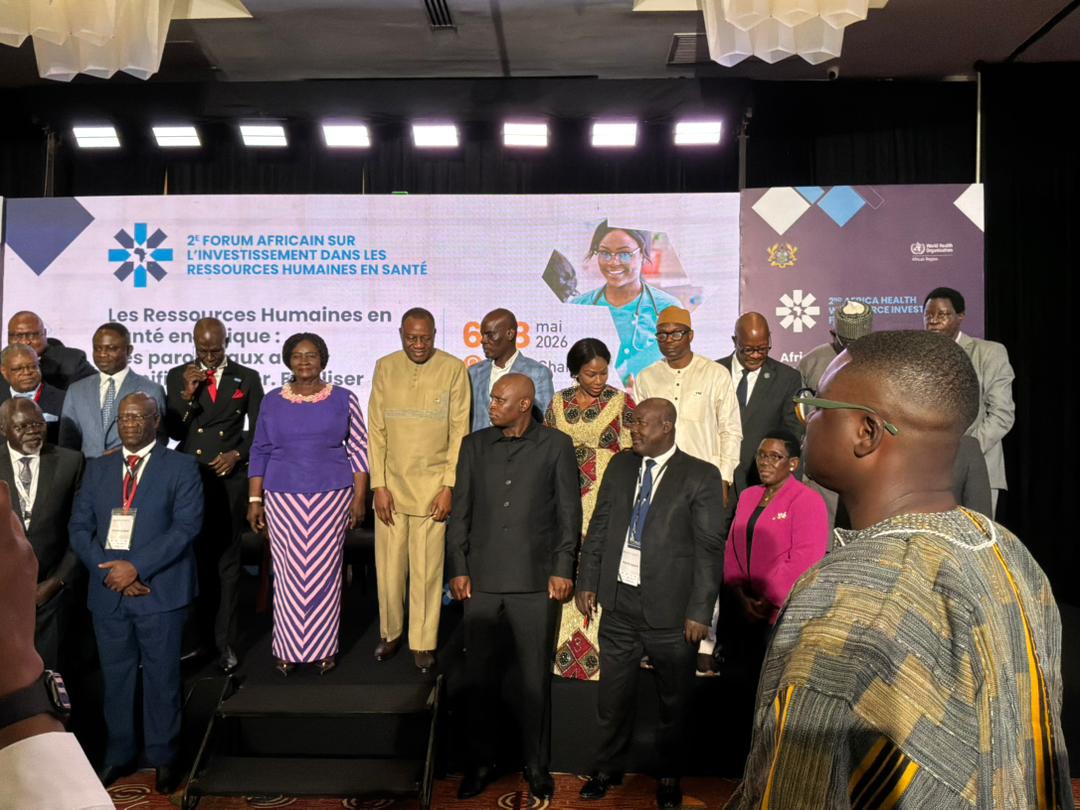
The Minister of State for Health and Social Welfare, Iziaq Adekunle Salako, made the position known at the 2nd Africa Health Workforce Investment Forum held in Accra, where stakeholders reviewed financing and staffing gaps across African health systems.
He said the continent’s current reality reflects a growing imbalance in global health labour mobility, where developing countries fund the training of health workers who are later absorbed by richer economies.
According to him, this pattern is no longer sustainable, especially as African countries continue to face shortages of doctors, nurses and other frontline health personnel.
Salako warned that Africa could still experience a deficit of about 6.1 million health workers by 2030 if corrective measures are not urgently implemented.
He stressed that financing remains a central challenge, noting that weak health investment continues to undermine progress toward Universal Health Coverage across the continent.
To address the situation, he proposed a structured global migration framework that would include investment obligations for destination countries, compensation mechanisms for source countries, and formalised circular migration arrangements.
Salako said Nigeria has already begun reforms in this direction through the National Policy on Health Workforce Migration, approved in August 2024.
He explained that the policy prioritises ethical recruitment practices, retention strategies, diaspora engagement, rural deployment, and bilateral health workforce agreements.
The policy also aligns with global standards set by the World Health Organization on international recruitment of health personnel.
He further disclosed that Nigeria, under President Bola Ahmed Tinubu, has introduced a $900 million Health Sector Renewal Investment Initiative aimed at strengthening primary healthcare systems between 2024 and 2026.
The programme, he said, focuses on infrastructure upgrades, workforce expansion, and scaling up community-based healthcare delivery.
Salako added that Nigeria has completed its National Health Workforce Country Profile and established a national workforce registry to improve planning and data management.
He said a Health Labour Market Analysis is also underway to support evidence-based investment decisions under the Africa Health Workforce Investment Charter.
On cap acity building, he noted that more than 70,000 frontline health workers have been retrained, with government targeting 120,000 as part of ongoing primary healthcare reforms.
The minister also highlighted wider pressures on Africa’s health systems, including declining external funding, rising disease outbreaks, and unemployment among trained health professionals.
He pointed to a significant drop in Overseas Development Assistance in recent years, warning that domestic systems must now carry greater responsibility for health financing.
He urged African governments to step up efforts in meeting the 15 per cent health budget commitment, noting that Botswana and Cabo Verde have already complied, while most other countries across the continent are still falling short of the target.
